"No refunds" is one of the most common lines in small-business terms, and one of the least effective. When goods are faulty, a customer's Consumer Rights Act 2015 refund rights come from the statute, not from your terms, and your terms cannot take them away. What your terms can do is explain those rights clearly and set out a sensible process for handling claims.
This post covers faulty goods, services and digital content. It does not cover change-of-mind cancellations, which come from a different law, the Consumer Contracts Regulations 2013. For those, see our explainer on the 14-day cooling-off rule.
The three promises every sale of goods makes
When you sell goods to a consumer, the contract is treated as including three terms whether you write them down or not:
- the goods are of satisfactory quality, judged by what a reasonable person would expect given the description, price and other circumstances (CRA 2015, s 9);
- they are fit for any particular purpose the customer told you about before buying, unless they did not rely on your skill or judgment (s 10);
- they match their description (s 11).
That last one matters more than many sellers realise. Your product listing is part of the contract. If the photos and wording do not match what arrives, that is a breach, even if the item works perfectly.
Consumer Rights Act 2015 refund rights for faulty goods, in order
The remedies come in a fixed sequence (s 19(3)).
1. The short-term right to reject (30 days). For most goods, the customer can reject faulty goods and get a full refund within 30 days of ownership passing and the goods being delivered (and installed, if you install them). Perishable goods can have a shorter period (s 22). Once the customer rejects, you must refund within 14 days of agreeing they are entitled to it, using the same payment method and without charging a fee, and you bear the reasonable cost of returning the goods (s 20).
2. Repair or replacement. The customer can ask for a repair or replacement instead, or after the 30 days. You must do it within a reasonable time, without significant inconvenience to them, and at your cost. The customer cannot insist on one if it is impossible or disproportionate compared with the other (s 23).
3. Price reduction or final right to reject. If one repair or replacement has not fixed the problem, or it cannot be done, or you have not done it in a reasonable time, the customer can choose a price reduction (which can be the full price) or reject the goods for a refund (s 24). On a final rejection you can make a deduction for use, but not if the rejection happens within six months of delivery (motor vehicles are the exception).
Two more points that catch sellers out:
- The six-month presumption. If a fault appears within six months of delivery, it is presumed to have been there on delivery, unless you can show otherwise or the presumption does not fit the goods or the fault (s 19(14) and (15)).
- Guarantees are extra. If you offer a guarantee, it is legally binding on its own terms, must say the customer's statutory rights are not affected, and must give your name, address, duration and territorial scope (s 30).
Services: care and skill, then put it right
For services, the key promise is that you will perform them with reasonable care and skill (s 49). Things you say about the service that the customer relies on also become binding (s 50).
If the service falls short, the customer can ask you to perform it again properly, within a reasonable time and at your cost (s 55). If that is impossible or you do not do it in reasonable time, they can require a price reduction, which can be the full price, refunded within 14 days (s 56; the overall scheme is in s 54).
Digital content: no right to reject, but still a refund route
Downloads, e-books, online courses and streamed content must also be of satisfactory quality, fit for purpose and as described (ss 34 to 36). There is no right to reject digital content. Instead the customer gets repair or replacement first (s 43), then a price reduction, which may be the full price, if that fails or takes too long (s 44).
If your digital content damages a customer's device or other content because you did not use reasonable care and skill, you must repair the damage or pay compensation (s 46). The immediate supply rules affect the right to cancel, not these quality rights; a customer who ticked the consent box can still complain that a course is faulty.
What your T&Cs can't say
These rights cannot be excluded or restricted by your terms. For goods, a term that excludes or limits liability under ss 9 to 17, or restricts the remedies, or makes them subject to onerous conditions, does not bind the consumer (s 31). The same applies to digital content (s 47) and to the care-and-skill duty for services. For services, a term limiting your liability can never stop the customer recovering the price paid in an appropriate case (s 57).
In practice, wording like this does not work against a consumer:
- "No refunds on sale items" (for faulty goods);
- "Faults must be reported within 48 hours";
- "Faulty items will be exchanged for store credit only";
- "You must pay return postage for faulty goods";
- "Goods must be returned unused in original packaging" (as a condition for a fault claim);
- "We are not responsible for products that are not as described".
Anything else that tips the balance against the customer can also be challenged as unfair (s 62). Our post on liability caps in UK T&Cs covers the wider limits.
What your T&Cs can say
Terms are still useful. They can:
- summarise the customer's rights in plain English, so you and they start from the same place;
- give a clear contact route for fault claims and say what information helps (order number, a photo, a description);
- explain that natural or handmade products may vary slightly, as long as that does not affect quality or make the item materially different from its description;
- set out any guarantee you offer, on top of the statutory rights;
- explain your complaints process and whether you use an ADR provider (see why your consumer terms should mention ADR).
How Trading Terms handles remedies
Trading Terms gives each product kind its own remedies wording. Goods get a summary of the 30-day right to reject, repair or replacement, and price reduction or refund. Services and workshops get the care-and-skill wording. Digital content gets repair or replacement, price reduction and the device-damage rule. Each says that nothing in the terms limits those rights. If you choose to offer a guarantee on goods, it is added as a separate clause that states it is in addition to the customer's legal rights. The terms do not try to cap liability to consumers or exclude statutory rights.
What the terms cannot do is handle claims for you. You still need to deal with fault claims within the time limits above, make sure your listings describe products accurately, and train anyone who answers customer emails not to say "no refunds".
When you need a solicitor
Get advice if you sell motor vehicles or high-value goods, if a dispute has already started, if a customer is claiming for injury or damage to property, or if you sell mainly to businesses (the Consumer Rights Act rules above apply to consumers). Trading Terms is for consumer sales by businesses in England and Wales, and the Trading Terms FAQs set out its other limits. If you are still weighing up your options, our comparison of a generator, a free template and a solicitor may help.
This is general information, not legal advice on your situation.
To get consumer terms that state these rights properly for each product you sell, see Trading Terms.
Sources
- Consumer Rights Act 2015, s 9
- Consumer Rights Act 2015, s 10
- Consumer Rights Act 2015, s 11
- Consumer Rights Act 2015, s 19
- Consumer Rights Act 2015, s 20
- Consumer Rights Act 2015, s 22
- Consumer Rights Act 2015, s 23
- Consumer Rights Act 2015, s 24
- Consumer Rights Act 2015, s 30
- Consumer Rights Act 2015, s 31
- Consumer Rights Act 2015, Part 1, Chapter 3 (digital content, ss 33 to 47)
- Consumer Rights Act 2015, Part 1, Chapter 4 (services, ss 48 to 57)
- Consumer Rights Act 2015, s 62
- Consumer Contracts Regulations 2013
Build your own terms
Selling to consumers? Trading Terms builds plain-English T&Cs for your business from a short set of questions. See the Trading Terms FAQ for what it covers.
Related reading
The Contract Studio Guides
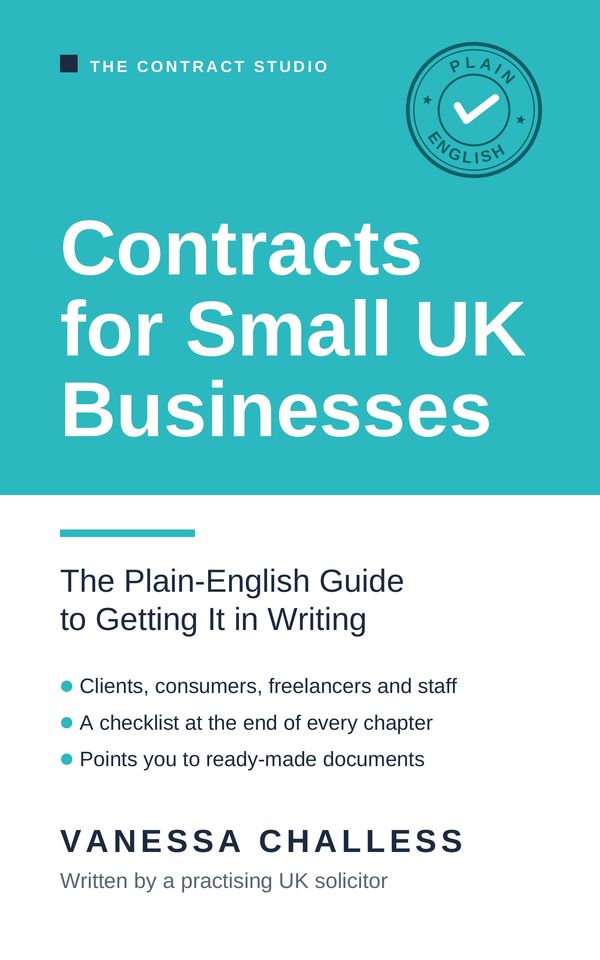
Contracts for Small UK Businesses
The Plain-English Guide to Getting It in Writing
Get it in writing before it matters. A plain-English guide for small UK business owners, freelancers and first-time employers, by a practising UK solicitor.