If you sell to the public, you have three realistic ways to get customer terms: download a free template, use a terms and conditions generator, or pay a solicitor. Searching for a "terms and conditions generator UK" turns up all three, often on the same page, and they are not the same thing. This post compares them honestly, including where a generator stops being the right answer.
If you are still deciding whether you need terms at all, start with how to tell whether you need T&Cs. This post assumes you do.
What the law expects your terms to do
Whatever route you choose, the document has a job to do. For consumer sales at a distance (online, by phone or by email), the Consumer Contracts Regulations 2013 require you to give specific information before the customer is bound, including the total price, delivery arrangements, the right to cancel and how to complain (CCRs 2013, reg 13 and Sch 2). If you sell online, you must also let customers store and reproduce your terms (Electronic Commerce (EC Directive) Regulations 2002, reg 9(3)).
The terms also have to be fair. A consumer is not bound by an unfair term (Consumer Rights Act 2015, s 62; the CMA explains how it applies the test in its unfair contract terms guidance), and some terms are simply void, such as anything that tries to exclude the statutory rights to goods that are of satisfactory quality, fit for purpose and as described (CRA 2015, s 31).
So the test for any option is not "does it look official?" but "does it say the right things, for what I actually sell, without anything the law will ignore?"
Free templates: cheap, but you do the checking
A free template costs nothing up front. The cost arrives later, in the checking. Common problems:
- Wrong country. Templates written for the US or for another jurisdiction mention "state law", disclaim warranties in capitals, or cap liability in ways that do not work against UK consumers.
- Wrong business model. A template written for a clothes shop says nothing useful about a workshop on a fixed date, a download or a subscription. Each of those has different cancellation rules.
- Out of date. UK consumer law has moved. The Digital Markets, Competition and Consumers Act 2024 changed the rules on pricing and unfair practices from April 2025, and a new subscription regime is on its way (see what the DMCC Act 2024 means for small online sellers).
- Someone else's copyright. Copying another trader's terms word for word can infringe their copyright (Copyright, Designs and Patents Act 1988, s 16), and you inherit their mistakes along with their wording.
A template can still work if you know enough to spot what is missing. Our guide to what a UK terms and conditions template must include is a useful checklist for that. Most small-business owners, reasonably, do not want to become that expert.
What a terms and conditions generator in the UK should do
A good generator sits between the two. You answer questions about how you sell; the tool assembles terms from fixed wording. The quality depends almost entirely on who wrote that wording and how the questions decide what goes in.
Things worth checking before you pay for any generator:
- Who drafted the clauses? Fixed, lawyer-drafted wording is different from text written on the fly by software.
- Does it treat different products differently? A mixed basket (say, a physical product and an online course) needs different cancellation and remedy wording for each line.
- Does it give you checkout wording? Some legal protections depend on your website, not your terms. More on that below.
- What happens when your business changes? Terms go stale the moment you add a new product type.
- Does it say clearly what it does not cover? If a generator claims to suit every business, be sceptical.
Trading Terms, our £195 generator, is built on those lines. The clause wording is fixed and solicitor-drafted; your answers decide which clauses appear and fill in your details. You list each product as goods, a service, a workshop, digital content or a subscription, and each kind gets its own rules. You get the terms in PDF and Word, a one-page Key Points summary, checkout wording, and a 12-month window to regenerate if your products change. It produces consumer terms only, for businesses in England and Wales. The Trading Terms FAQs set out the full scope, including what AI does and does not do in the process.
The part templates and generators often miss: your checkout
Terms on a page do not do everything. Several consumer rules turn on what happens when the customer clicks:
- The final order button must make clear the customer is committing to pay. If it does not, the consumer is not bound (CCRs 2013, reg 14(3) to (5)).
- Customers lose the right to cancel digital content only if they expressly ask for immediate supply and acknowledge they lose that right, and you confirm it (CCRs 2013, reg 37). Our digital content explainer covers this in more detail.
- You cannot add extra payments through pre-ticked boxes (CCRs 2013, reg 40).
Trading Terms includes a separate checkout document for whoever builds your site: the unticked boxes, the order button wording, the confirmation email and the records to keep. It only protects you if your website actually uses it. That part is still your job, or your developer's.
What a solicitor gives you that neither can
A solicitor reads your situation, not just your answers. They can advise on a live complaint, negotiate with a large customer, handle a regulator's letter, and draft for situations no fixed clause library covers. You pay for that judgment, so bespoke terms usually cost more than a generator; ask for a fixed fee quote.
You need a solicitor rather than a template or generator if:
- you sell mainly to other businesses (consumer terms are the wrong document; see our B2B vs B2C explainer for why one set rarely fits both);
- you are in a regulated sector, such as financial services, healthcare or gambling;
- you run a marketplace or platform where other sellers trade;
- most of your customers are outside the UK, or you need bilingual terms;
- you are in the middle of a customer dispute or have heard from Trading Standards or the CMA.
Trading Terms is not designed for any of those, and says so.
A quick comparison
- Free template: no cost up front; you check it against UK law, adapt it to each product, write your own checkout wording and keep it current.
- Generator (Trading Terms): £195; fixed solicitor-drafted wording selected by your answers, per-product rules, checkout wording, 12-month regenerate window; consumer terms only, England and Wales, outside regulated sectors. You still check the output fits how you work, wire up the checkout and write your privacy notice.
- Solicitor: highest cost; advice on your specific risks, live disputes and anything unusual.
Plenty of businesses use a generator now and a solicitor later, when the business or the risk grows. That is a sensible order, as long as you notice when you have crossed the line.
This is general information, not legal advice on your situation.
If you sell to consumers in England or Wales and your business fits the scope, build your consumer terms with Trading Terms.
Sources
- Consumer Contracts (Information, Cancellation and Additional Charges) Regulations 2013, Sch 2
- Consumer Contracts Regulations 2013, reg 14
- Consumer Contracts Regulations 2013, reg 37
- Consumer Contracts Regulations 2013, reg 40
- Electronic Commerce (EC Directive) Regulations 2002, reg 9
- Consumer Rights Act 2015, s 31
- Consumer Rights Act 2015, s 62
- Copyright, Designs and Patents Act 1988, s 16
- CMA, Unfair contract terms guidance (CMA37)
Build your own terms
Selling to consumers? Trading Terms builds plain-English T&Cs for your business from a short set of questions. See the Trading Terms FAQ for what it covers.
Related reading
The Contract Studio Guides
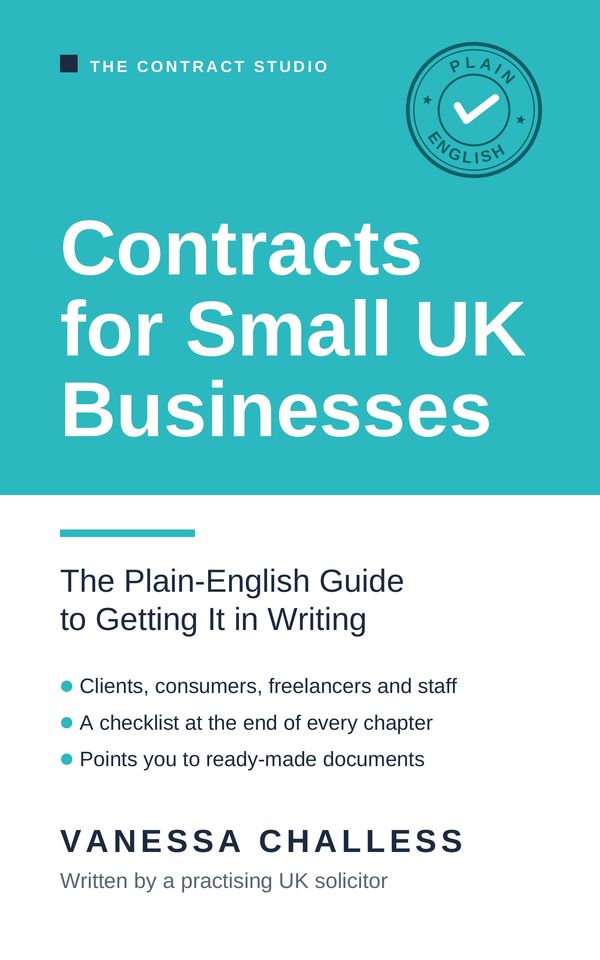
Contracts for Small UK Businesses
The Plain-English Guide to Getting It in Writing
Get it in writing before it matters. A plain-English guide for small UK business owners, freelancers and first-time employers, by a practising UK solicitor.