Most small UK businesses start with a logo, a website and a way to get
paid, then quietly ignore terms and conditions until something goes
wrong. That works right up to the first refund battle, missed deadline
or social-media complaint. At that point, everyone goes hunting for
"what we agreed" and discovers it lives in fifteen emails and an
Instagram
DM.
So how do you know if you've crossed the line from "messy but fine" into
"you really should have T&Cs by now"? The law doesn't give you a neat
quiz, but it does give you some obvious triggers.
1. You sell to consumers, not just other businesses
If any of your buyers are individuals acting outside their trade or
profession, you're in consumer-law territory. CRA
2015 gives those customers extra rights when goods, services or digital
content are faulty or not as described. CCR
2013 sets out cancellation rights for distance and off-premises contracts.
Clear T&Cs are the simplest way to explain those rights and how you
handle them.
2. You sell online or at a distance
If you take orders through a website, over the phone or via email,
you're making "distance" contracts under gov.uk
guidance The rules say you must provide specific information -- price, delivery,
cancellation, complaint routes -- on a durable medium your customer can
save. Dumping everything into a pretty homepage is not enough; putting
T&Cs somewhere stable is what makes you compliant.
3. You take deposits or pre-payments
Once you take deposits, upfront fees or staged payments, you need to
spell out what happens if a booking moves, a client cancels or you need
to rearrange. CMA consumer
guidance is very clear that unfair cancellation fees and non-refundable deposits
can be challenged. T&Cs let you set reasonable rules instead of arguing
every case from scratch.
4. You sell anything personalised, made-to-order or on specific
dates
Personalised goods, made-to-order items and certain time-specific
services sit in slightly different buckets under the distance-selling
rules. CCRs
2013 carve out some contracts from standard cancellation rights -- but only
if you explain clearly what the customer is getting and how cancellation
works. T&Cs are where that explanation lives.
5. You use customer data for more than just one order
If you collect names, addresses, emails or payment details and keep
them, you've wandered into data-protection territory. UK GDPR
guidance and PECR expect you to tell people how you use their data and how marketing
messages work. Your privacy notice does most of that work, but your T&Cs
back it up by pointing customers in the right direction.
6. You care about getting paid on time
Late payment is a fact of life. Without written terms you're relying on
"reasonable expectations" and polite chasing. With T&Cs you can set
clear payment deadlines, late-payment interest and the right to pause
work or withhold access if invoices aren't settled. That makes
conversations with slow payers much more
straightforward.
7. You'd rather avoid arguing about scope and deliverables
Most disputes in service businesses are about "what was included".
Well-drafted T&Cs link up with your proposals or order forms so scope,
fees and deliverables fit into a coherent story. When someone asks for a
full re-brand based on a logo package, you can point to the contract
instead of relying on
memory.
If at least two of those apply to you, you probably need proper T&Cs
rather than another year of improvisation. You don't have to turn into a
lawyer; you just need a document that reflects UK consumer and
distance-selling rules, and matches how you actually run your business.
Configure your T&Cs in 10 minutes — Build my Trading Terms →
Build your own terms
Selling to consumers? Trading Terms builds plain-English T&Cs for your business from a short set of questions. See the Trading Terms FAQ for what it covers.
Related reading
The Contract Studio Guides
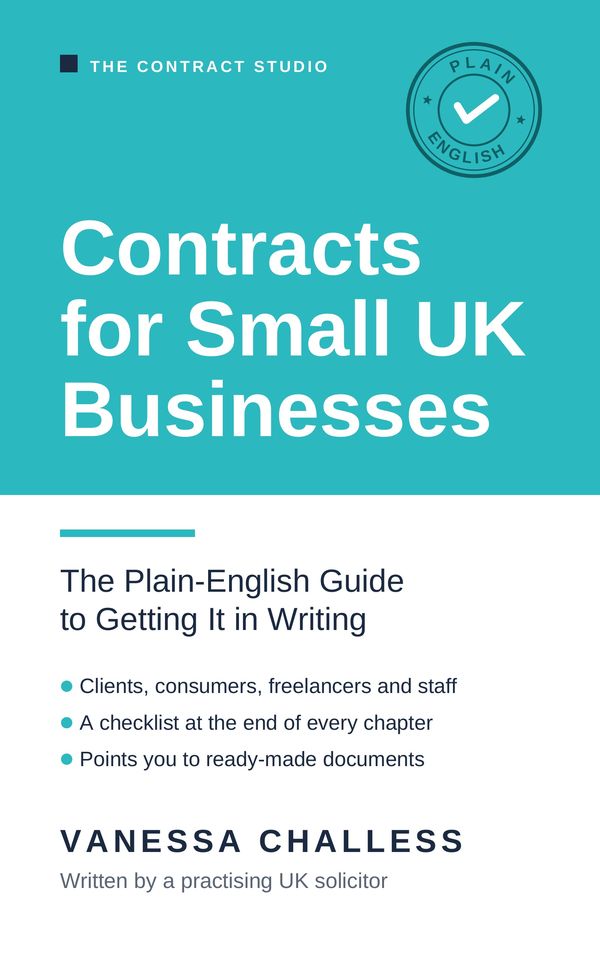
Contracts for Small UK Businesses
The Plain-English Guide to Getting It in Writing
Get it in writing before it matters. A plain-English guide for small UK business owners, freelancers and first-time employers, by a practising UK solicitor.