If someone other than your employee made something your business needs to own (a founder, a freelancer, an agency, a friend who "did the logo"), ownership only moves when they sign it over. An intellectual property assignment deed is the document that does that. This post covers what an assignment needs to work, why a deed, the moral rights waiver, and how to sign a deed validly.
What an intellectual property assignment deed does
An assignment transfers ownership. Once it takes effect, the business owns the copyright, design or trade mark, and the person who made it no longer does. A licence is different: it is permission to use something while the owner keeps it. Use the word you mean. Our post on IP in commercial contracts: retain, licence-on-payment, or assign? covers when a licence is the better choice.
It is needed because the creator of a work is its first owner, unless they are an employee acting in the course of employment (CDPA 1988, s 11). Who actually owns the logo? shows how this plays out with commissioned branding.
The legal minimum: writing and a signature
For each main IP right, the law sets a minimum formality.
- Copyright: an assignment "is not effective unless it is in writing signed by or on behalf of the assignor" (CDPA s 90(3)).
- Registered trade marks: the same rule, in writing signed by or on behalf of the assignor (Trade Marks Act 1994, s 24(3)).
- Registered designs: the same rule (Registered Designs Act 1949, s 15B(3)).
- Patents and applications: an assignment is void unless it is in writing and signed by or on behalf of the assignor (Patents Act 1977, s 30(6)).
None of these requires a deed. What matters is the signature of the person who owns the rights. Your own signature, as the buyer, is not enough, and a paid invoice is not an assignment.
Future work can be dealt with too. An agreement signed by the prospective owner that purports to assign future copyright means the copyright vests in the business as soon as the work is made (CDPA s 91(1)). That is why it is best to sign at the start of a project, not at the end.
Why use a deed?
If a signed letter works, why go to the trouble of a deed? A few reasons:
- A power of attorney must be a deed. A good assignment lets the business sign follow-up documents in the assignor's name if they will not (for example, a form to record the change of owner at a registry). An instrument creating a power of attorney must be executed as a deed (Powers of Attorney Act 1971, s 1(1)), and a power given as security can be irrevocable (s 4(1)).
- A longer limitation period. An action "upon a specialty" has a 12-year limit (Limitation Act 1980, s 8), compared with six years for a simple contract (s 5), and courts apply the 12-year period to claims under a deed (for example Lendlease Construction (Europe) Ltd v Aecom Ltd [2023] EWHC 2620 (TCC) at [111]). Title problems can surface many years later, at a sale or investment.
The moral rights waiver
Authors of copyright works have moral rights, including the right to be identified as the author (CDPA s 77) and the right to object to derogatory treatment of the work (s 80). Moral rights are not assignable (s 94), so an assignment of copyright leaves them with the author.
They can, however, be waived "by instrument in writing signed by the person giving up the right" (CDPA s 87(2)). A waiver can cover existing or future works, and if it is made in favour of the copyright owner it is presumed to extend to their licensees and successors unless the waiver says otherwise (s 87(3)).
Two details:
- The right to be identified and the right to object do not apply to computer programs (CDPA s 79(2)(a) and s 81(2)), but most works delivered to a business include something else (designs, text, images), so the waiver is still worth having.
- If an agency did the work, the people with moral rights are the individuals who made it, not the agency. The agency needs signed waivers from them.
How to sign a deed properly
This is where many assignments fail on a technicality.
- It must say it is a deed on its face, and be validly executed as one (Law of Property (Miscellaneous Provisions) Act 1989, s 1(2)).
- Individuals sign in the presence of a witness, who attests the signature (s 1(3)).
- Companies sign by two authorised signatories (directors, or a director and the company secretary), or by one director in the presence of a witness (Companies Act 2006, s 44), and the document must be delivered as a deed (s 46).
- The witness should be physically present. The Law Commission's view is that "in the presence of a witness" requires physical presence, even where both people sign electronically. A court might accept remote witnessing, but you cannot be confident of it (Law Com No 386, Electronic execution of documents, paras 5.30 to 5.35).
- Do not sign a loose signature page. The signature and attestation should form part of the same physical document (R (Mercury Tax Group Ltd) v HMRC [2008] EWHC 2721 (Admin)). Sign the final, complete version.
What the business gives in return
The Made & Owned IP pack deed offers three consideration options:
- £1, the simplest founder route. The £1 must actually be paid. A nominal price does not switch anything else off: if the assignor is a director (or connected with one) and the IP is a substantial non-cash asset, members' approval may still be needed (Companies Act 2006, s 190, thresholds in s 191), directors still owe their duties, and HMRC may look at market value. Take advice from your accountant before signing.
- Shares, common at incorporation. The deed is conditional on the company approvals, and the IP and the shares change hands at the same moment. Directors value the IP themselves, honestly, and write down how they got there; courts give a company a fair degree of latitude in valuing non-cash consideration for shares (Chalcot Training Ltd v Ralph [2020] EWHC 1054 (Ch) at [254]). The pack's Company Approvals document gives the board minute and members' resolution. If you also need a shareholders' agreement, see the Founders & Shares pack.
- The fee, for freelancers and agencies, under the services agreement or invoice.
After signing
- Record registered rights. Until an application to register a trade mark assignment is made, it is ineffective against someone who later acquires a conflicting interest in ignorance of it, and you may lose costs in an infringement claim if you do not apply within six months (Trade Marks Act 1994, s 25(3) and (4)). Patents have a similar costs rule (Patents Act 1977, s 68). For registered designs, an unrecorded document may not be admitted as evidence of title unless the court directs otherwise (Registered Designs Act 1949, s 19(5)). Check current forms and fees on gov.uk.
- Collect the files (source code, editable artwork, domain codes, logins) and keep a complete signed copy.
What the pack's deed includes
The deed has three routes (founder into company, freelancer or agency deliverables, and confirmatory assignment of past work), a present assignment of existing and future rights with full title guarantee, a moral rights waiver, a handover clause, further assurance with a power of attorney, and a disclosure schedule for background IP, third-party materials and generative AI use. The guide explains each clause, and the Signing Day Checklist gives the order of steps for each route. Answers to common questions are on the Made & Owned FAQ page. If you are the creative assigning your work to a client, the Creatives pack is written for your side.
When you need a solicitor
Speak to a solicitor if the assignor will not sign or cannot be found, if the IP is central to a fundraising or sale, if someone else claims to own it, or if patents or overseas rights are involved.
This is general information, not legal advice on your situation.
The deed, signing checklist and company approvals are in the Made & Owned IP pack.
Sources
- Copyright, Designs and Patents Act 1988, s 11
- Copyright, Designs and Patents Act 1988, ss 77, 79, 80, 81
- Copyright, Designs and Patents Act 1988, s 87
- Copyright, Designs and Patents Act 1988, s 90
- Copyright, Designs and Patents Act 1988, s 91
- Copyright, Designs and Patents Act 1988, s 94
- Trade Marks Act 1994, s 24
- Trade Marks Act 1994, s 25
- Registered Designs Act 1949, s 15B
- Registered Designs Act 1949, s 19
- Patents Act 1977, s 30
- Patents Act 1977, s 68
- Powers of Attorney Act 1971, s 1 and s 4
- Limitation Act 1980, s 5 and s 8
- Law of Property (Miscellaneous Provisions) Act 1989, s 1
- Companies Act 2006, s 44, s 46, s 190 and s 191
- Law Commission, Electronic execution of documents (Law Com No 386, 2019)
- Lendlease Construction (Europe) Ltd v Aecom Ltd [2023] EWHC 2620 (TCC)
- R (Mercury Tax Group Ltd) v HMRC [2008] EWHC 2721 (Admin)
- Chalcot Training Ltd v Ralph [2020] EWHC 1054 (Ch)
Make sure your business owns its IP
IP: Made & Owned has the IP assignment deed, one-way and mutual NDAs, an IP licence and company approvals for UK businesses. Questions first? Read the IP FAQ.
Related reading
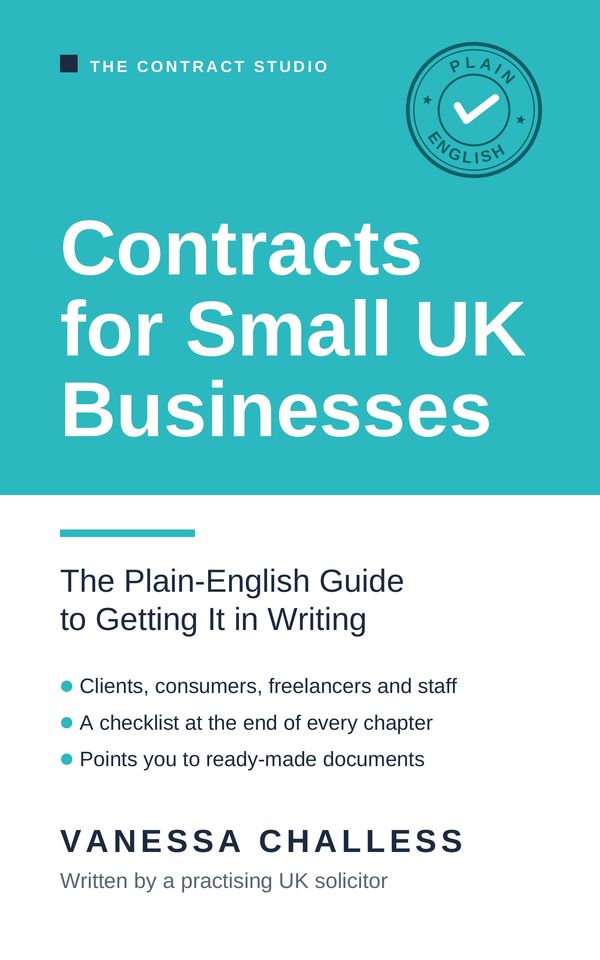
The Contract Studio Guides
Contracts for Small UK Businesses
The Plain-English Guide to Getting It in Writing
Get it in writing before it matters. A plain-English guide for small UK business owners, freelancers and first-time employers, by a practising UK solicitor.