Most small businesses assume that anything a member of staff makes at work belongs to the business. For employees, that is largely right. But the rules differ between copyright, designs and inventions, the word "employee" is narrower than many people think, and inventions come with statutory rights that a contract cannot take away. This post explains who owns intellectual property created by an employee, where the edges are, and what an IP clause in an employment contract should do.
The starting point: the author owns the work
The general rule for copyright is that the person who creates a work is its author and first owner (CDPA 1988, s 9(1) and s 11(1)). That is why work bought from freelancers and agencies needs a signed assignment, as our post on who owns intellectual property made by a freelancer or contractor explains.
Employees are the main exception.
Who owns intellectual property created by an employee: copyright
Where a literary, dramatic, musical or artistic work, or a film, is made by an employee in the course of their employment, the employer is the first owner of the copyright, subject to any agreement to the contrary (CDPA s 11(2)). A computer program is a literary work (CDPA s 3(1)), so this covers code as well as documents, images and marketing material.
Two parts of that rule matter in practice.
"Employee" has a narrow meaning. It means employment under a contract of service or of apprenticeship (CDPA s 178). Freelancers, consultants, contractors working through their own company, and agency workers are generally not your employees for this purpose. Nor, automatically, are directors: a director can also be an employee, but it is a question of fact (Secretary of State for BERR v Neufeld [2009] EWCA Civ 280 at [80] to [81]). If a founder director has no service agreement, do not assume the company owns what they make. Our guide to employee vs self-employed vs IR35 covers how status is worked out.
"In the course of employment" is not "at any time while employed". A marketing assistant who writes a novel at the weekend owns the novel. Work that falls outside someone's job can be harder to call, especially for senior staff or anyone working from home on their own equipment. A clear job description and IP clause reduce the room for argument.
The words "subject to any agreement to the contrary" also cut both ways: an employment contract can leave copyright with the employee if that is what you agree.
Designs
Designs follow the same pattern. For UK unregistered design right, where a design is created by an employee in the course of employment, the employer is the first owner (CDPA s 215(3)). For registered designs, the employer is treated as the original proprietor (Registered Designs Act 1949, s 2(1B)).
Inventions: Patents Act 1977, sections 39 to 42
Inventions have their own code, and it is more balanced towards the employee.
An invention made by an employee belongs to the employer only if (Patents Act 1977, s 39(1)):
- it was made in the course of the employee's normal duties, or duties specifically assigned to them, and the circumstances were such that an invention might reasonably be expected to result; or
- it was made in the course of their duties and, because of the nature of those duties, they had a special obligation to further the interests of the employer's business. This second limb tends to matter most for senior staff.
Any other invention made by an employee belongs to the employee (s 39(2)).
You cannot simply contract around this. A term in a contract with an employee that diminishes their rights in inventions made after the contract is unenforceable against them to that extent, although duties of confidentiality are preserved (s 42(2) and (3)). An IP clause that says "everything you invent, at any time, belongs to us" will not work for inventions the statute gives to the employee.
Employees can also claim compensation. Where a patented invention belonging to the employer is of "outstanding benefit" to the employer, having regard among other things to the size and nature of the business, the court or the Comptroller may award the employee compensation (s 40(1)). This is rare, but it happens: in Shanks v Unilever plc [2019] UKSC 45, the Supreme Court held that the patents were of outstanding benefit and awarded the inventor £2 million ([93]).
If your staff may invent something patentable, speak to a registered patent attorney early, and before anyone describes the invention outside the business.
Moral rights and employees
Authors of copyright works usually have moral rights, including the right to be identified. That right does not apply to anything done by or with the authority of the copyright owner where the copyright first vested in the employer under section 11(2) (CDPA s 79(3)). It also does not apply to computer programs at all (s 79(2)(a)). Many employers still ask for a signed waiver, which the law allows (CDPA s 87(2)).
What an IP clause in an employment contract should do
Because the statute already gives the employer most of what it needs, the IP clause in an employment contract is mainly about clarity and co-operation. A sensible clause will usually:
- confirm that IP created in the course of employment belongs to the employer, and describe the employee's duties clearly enough to show what that covers;
- require the employee to tell you promptly about anything they create or invent that relates to the business;
- deal with the grey areas, such as work done outside hours that uses the business's equipment or confidential information;
- include an assignment of any rights that do not pass automatically, so far as the law allows, without trying to take inventions that section 39(2) gives to the employee;
- include a moral rights waiver and a duty to sign further documents, for example for a patent or design application; and
- deal with confidentiality during and after employment, which survives even where invention rights do not.
The People & HR pack includes employment contracts for small businesses, and our post on what to include in a UK employment contract covers the wider document.
Where the Made & Owned pack fits
The Made & Owned IP pack is not a replacement for employment contracts. It deals with the people outside the employment rule: freelancers, agencies, and founders and directors without a service agreement. Its guidance is clear that you should not use the IP Assignment Deed to take an employee's invention, because of the statutory rules above.
What it does help with for employers:
- the IP Register records who made each asset and whether the paperwork is in place, which shows up the director or contractor whose work was never assigned;
- the IP Assignment Deed (founder and confirmatory routes) closes gaps for directors and founders who were never employees, with Company Approvals for a director assigning IP to the company; and
- the One-Way and Mutual NDAs protect information you share with people who are not your employees.
For more, see the Made & Owned FAQ page.
When you need a solicitor
Take advice if an employee has made an invention, or claims to own something the business relies on; if a director or senior employee is leaving and there is a dispute about what they can take; or if someone has raised a compensation claim under section 40. Employee invention cases turn on the facts and are not template territory.
This is general information, not legal advice on your situation.
To close the IP gaps that employment contracts do not cover, see the Made & Owned IP pack.
Sources
- Copyright, Designs and Patents Act 1988, s 3
- Copyright, Designs and Patents Act 1988, s 9
- Copyright, Designs and Patents Act 1988, s 11
- Copyright, Designs and Patents Act 1988, s 79
- Copyright, Designs and Patents Act 1988, s 87
- Copyright, Designs and Patents Act 1988, s 178
- Copyright, Designs and Patents Act 1988, s 215
- Registered Designs Act 1949, s 2
- Patents Act 1977, s 39
- Patents Act 1977, s 40
- Patents Act 1977, s 42
- Secretary of State for BERR v Neufeld [2009] EWCA Civ 280
- Shanks v Unilever plc [2019] UKSC 45
Make sure your business owns its IP
IP: Made & Owned has the IP assignment deed, one-way and mutual NDAs, an IP licence and company approvals for UK businesses. Questions first? Read the IP FAQ.
Related reading
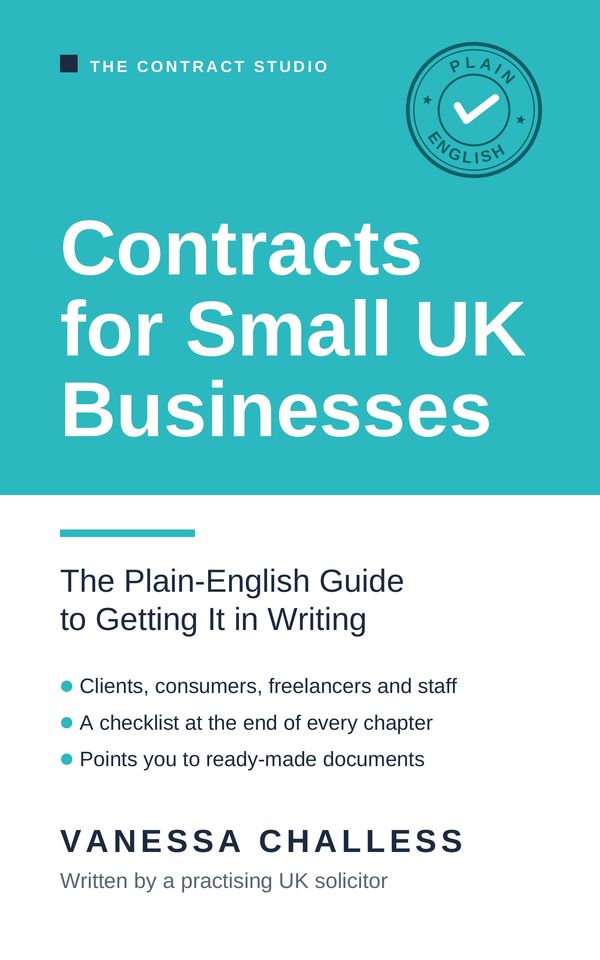
The Contract Studio Guides
Contracts for Small UK Businesses
The Plain-English Guide to Getting It in Writing
Get it in writing before it matters. A plain-English guide for small UK business owners, freelancers and first-time employers, by a practising UK solicitor.