A business client pays a deposit, then pulls out. Can you keep it? And does it matter if you asked for 30%, or 50%?
There is no universal maximum deposit for business-to-business contracts. Nor is there a percentage that automatically makes a deposit safe to keep. The answer depends on what the payment is for, what the contract says and whether the forfeiture provision is enforceable.
This post covers business-to-business sales in England and Wales. Consumer contracts follow different, stricter rules, covered in our earlier guide, Deposits, non-refundable deposits, and the law.
Is it really a deposit, or just a payment in advance?
The label does not settle it. Courts look at what a payment does, not what you call it (Cavendish Square Holding BV v Makdessi [2015] UKSC 67, para 15).
A true deposit is "earnest money": a guarantee that the buyer will go through with the deal. If the deal completes, it counts towards the price. If the buyer breaks the contract and the seller ends it, the seller can usually keep a reasonable deposit without proving any loss.
A part payment, or advance payment, is simply some of the price paid early. If the contract ends before you deliver, the buyer may be able to get it back, because the price is no longer due. The Court of Appeal set out this distinction in Glaser v Atay [2024] EWCA Civ 1111, paras 130 to 133. Glaser concerned a consumer contract for legal services. Its discussion helps explain the distinction between deposits and advance payments, but its consumer-fairness ruling does not apply to B2B contracts.
Glaser also separates two questions that are easy to run together. One is whether the customer has to pay an instalment when it falls due. The other is whether you can keep money already paid once the contract has ended (paras 128 and 129). A clause that makes a payment due on a date does not, by itself, answer the second question.
So decide, and say in writing, what each payment is.
Is there a percentage that is safe?
Not in business contracts generally. The well-known 10% figure comes from sales of land. In Workers Trust & Merchant Bank Ltd v Dojap Investments Ltd [1993] AC 573, the Privy Council treated 10% as the customary deposit on a land sale. It said a seller who wants a bigger forfeitable deposit "must show special circumstances which justify such a deposit". The 25% deposit in that case failed. Lord Hodge adopted that approach for English law in Makdessi (para 238).
The land-sale benchmark does not establish a generally applicable percentage for business contracts for goods or services. Where the penalty rule applies, the question is whether the provision imposes a detriment "out of all proportion to any legitimate interest of the innocent party in the enforcement of the primary obligation" (Makdessi, para 32). Lord Hodge put it as whether the sum is "exorbitant or unconscionable" (para 255). In a negotiated deal between properly advised businesses, courts start from a strong presumption that the parties are the best judges of what is legitimate (para 35).
In Amaal Ventures Ltd v Eros Ltd [2026] EWHC 870 (Ch), off-plan flat buyers paid 30% in advance. The judge accepted that the developer's risks justified more than the usual 10% (paras 186 to 194). This was a first-instance land case, and the seller's termination was held ineffective. Its discussion of the 30% payment is useful, but it is not a general approval of 30% deposits in business contracts.
What happens if the deposit is too big?
If a court decides your deposit is really a penalty, you cannot keep it simply because the contract says so. In Workers Trust the money was ordered to be repaid, less the loss the seller actually proved. That is exactly the exercise a deposit is meant to spare you.
A deposit is not a licence to keep the customer's money when you wrongfully refuse to perform. If you end the contract because of the customer's breach, the position is different.
Is there a general power to order a refund?
Section 49(2) of the Law of Property Act 1925 gives the court a discretion to order repayment of a deposit, but section 49(3) confines that provision to contracts for the sale or exchange of an interest in land. It does not provide an equivalent general refund power for ordinary business contracts for goods or services.
Does the Unfair Contract Terms Act 1977 apply?
The Consumer Rights Act 2015 fairness test does not apply between businesses. However, where a customer deals on your written standard terms, section 3 of the Unfair Contract Terms Act 1977 may apply. Subject to its scope and exceptions, it requires reasonableness for terms excluding or restricting liability for your own breach, or allowing you to provide substantially different performance or no performance at all. The party relying on the term must establish that it is reasonable.
A clause letting you keep a deposit when the client breaks the contract is not usually that kind of term. A blanket "non-refundable in all circumstances" clause, which would let you keep the money even when you are the one in breach, looks much more like one.
Worked example: a joiner taking 50% upfront on a bespoke kitchen
This example is invented for illustration. It is not a real case or client.
A joinery firm agrees to build and fit a bespoke kitchen for a café for £20,000, and asks for 50% (£10,000) on signing. Three weeks later, with the oak bought and cut to size, the café cancels.
If the contract called the whole £10,000 a "non-refundable deposit", the café could argue that half the price is not reasonable as earnest money, and the joiner would have to justify it.
A clearer structure separates any booking deposit from payments for materials and completed stages of work. The contract should explain what each payment covers and how the account will be settled if the customer cancels. Calling a materials payment "non-refundable" does not, by itself, settle whether the joiner can keep it.
Worked example: a venue taking 40% for a corporate dinner
This example is also invented for illustration.
A venue takes 40% for a corporate dinner booked 11 months ahead. Whether it can retain that payment after cancellation depends first on what the payment actually is: a deposit, an advance payment or a cancellation charge. A sliding scale may better reflect the increasing commercial risk as the event approaches, but it is not automatically enforceable simply because it rises over time.
If the venue instead claims damages for breach, replacement bookings and costs saved will matter when assessing its loss.
Before you set your deposit
- Decide whether each payment is a deposit, an advance payment or a cancellation charge, and label it that way in the contract.
- Choose the amount by reference to the transaction, any established trade practice and the commercial risk the payment protects against. Do not assume that 10% is automatically safe, or that a higher percentage is automatically unenforceable.
- Link larger upfront sums to stages of work or costs you will actually incur, and say how the account is settled if the contract ends early.
- Say that the deposit is refunded if you wrongfully cancel or fail to perform. Make clear that a different position applies where you end the contract because of the customer's breach. Avoid "non-refundable in all circumstances".
- Note why you chose the figure.
- If you also sell to consumers, review those terms separately. Different rules apply to consumer deposits and cancellation charges.
This is general information about the law of England and Wales, not legal advice. Take advice on your own contract before relying on a deposit clause.
Authorities referred to
- Cavendish Square Holding BV v Makdessi; ParkingEye Ltd v Beavis [2015] UKSC 67
- Workers Trust & Merchant Bank Ltd v Dojap Investments Ltd [1993] AC 573 (Privy Council)
- Glaser v Atay [2024] EWCA Civ 1111
- Amaal Ventures Ltd v Eros Ltd [2026] EWHC 870 (Ch)
- Law of Property Act 1925, section 49
- Unfair Contract Terms Act 1977, section 3 and section 11
Build your own terms
Selling to consumers? Trading Terms builds plain-English T&Cs for your business from a short set of questions. See the Trading Terms FAQ for what it covers.
Related reading
The Contract Studio Guides
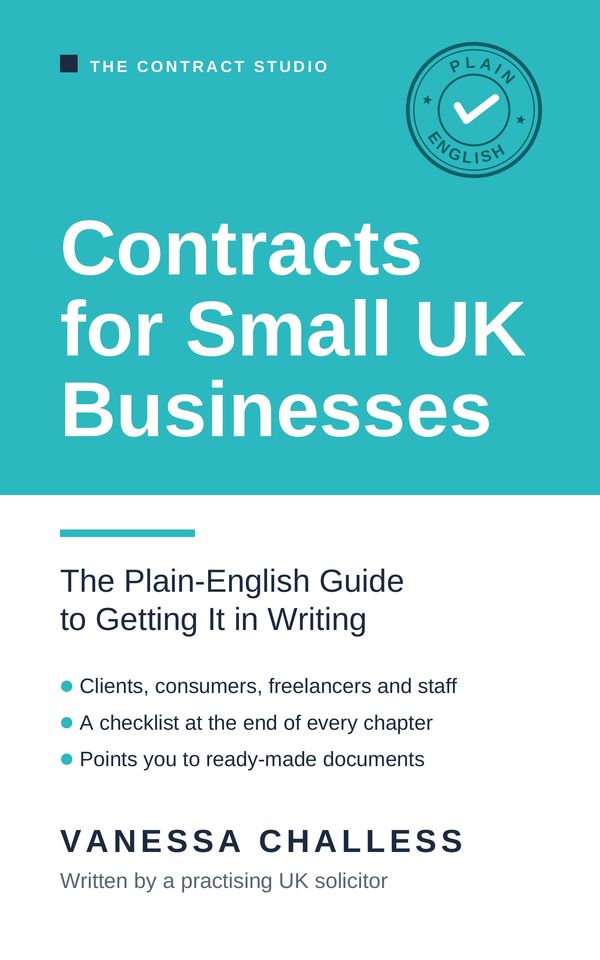
Contracts for Small UK Businesses
The Plain-English Guide to Getting It in Writing
Get it in writing before it matters. A plain-English guide for small UK business owners, freelancers and first-time employers, by a practising UK solicitor.