If you let a house or flat in England, the tenancy paperwork changed on 1 May 2026. The written statement of terms under the Renters' Rights Act is now a legal requirement: you must give your tenant a written statement of the tenancy's terms before the tenancy is entered into, and regulations list exactly what it has to contain. Get it wrong and the council can fine you.
This post explains what the statement must include, when you have to give it, and what to do about tenants who were already in place before May 2026. It covers England only. Wales, Scotland and Northern Ireland have their own systems.
Where the rule comes from
The Renters' Rights Act 2025 inserted a new section 16D into the Housing Act 1988. It says the landlord must give the tenant a written statement of the terms specified in regulations, and any other information the regulations require (Housing Act 1988, s 16D(2)). The statement can be the tenancy agreement itself, or a record of terms agreed some other way.
The detail is in the Assured Tenancies (Private Rented Sector) (Written Statement of Terms etc and Information Sheet) (England) Regulations 2026, SI 2026/324, which came into force on 1 May 2026 alongside the main reforms (SI 2026/421, reg 2).
The deadline: before the tenancy is entered into
For a new tenancy, the statement must be given before the tenancy is entered into (s 16D(4)). Not on move-in day, and not "within 28 days". In practice that means sending it to the tenant to read before anyone signs, and keeping proof of the date you sent it. An email with the document attached is the simplest evidence.
The penalty for failing to comply is a civil penalty of up to £7,000, imposed by the local housing authority (Housing Act 1988, s 16I(1)(a) and (6)).
What the written statement must contain
The Schedule to SI 2026/324 lists 18 items (SI 2026/324, Schedule Part 1). In plain English:
- The name of every landlord.
- The name of every tenant.
- An address in England and Wales where the tenant can serve notices, including court papers, on you.
- The address of the property.
- The date the tenant is first entitled to possession.
- The rent and when it is due.
- A statement that any new proposal to increase the rent must be made by a notice under section 13 of the Housing Act 1988.
- For any "relevant bill" the tenant pays to you (council tax, utilities, TV licence, broadband or phone, green deal payments): that it is payable, whether it is in the rent or on top, and if on top, the amount and due date or how you will tell the tenant.
- The amount of any tenancy deposit.
- The minimum notice the tenant must give to leave.
- A security of tenure statement: in most cases you can only end the tenancy with a court order, after serving a notice in the prescribed form that names the ground.
- Your duty to keep the property fit for human habitation.
- Your repairing obligations under section 11 of the Landlord and Tenant Act 1985 (with narrow exceptions).
- Your electrical safety duties under the 2020 regulations.
- Your gas safety duties, where there is a relevant gas fitting.
- Information about section 190 of the Equality Act 2010 (disabled tenants' improvements), where the tenant may make improvements with your consent.
- A statement that the tenant may ask to keep a pet and you must not unreasonably refuse.
- If it is supported accommodation, a statement saying so and why.
Several items have precise wording requirements. Item 11, for example, needs to explain the court order requirement and the prescribed notice. Item 8 catches landlords who include broadband or water in the rent: you still need to say so, bill by bill. Council tax and a TV licence can only be "included in rent" if the tenant pays them to you; otherwise the tenant pays the council or TV Licensing direct (Tenant Fees Act 2019, Sch 1 paras 8 and 10).
Prior-notice grounds have to be set up now
Some possession grounds need the written statement to say, before the tenancy starts, that you may wish to rely on them. These include Ground 4A (student lets), Ground 1B, Grounds 2ZA to 2ZD, 4, 5 to 5H, 6A and 18 (s 16D(3)). Without the statement, Ground 4A is not available at all. For the others, relying on them without it does not stop the court making an order, but it is a breach that can lead to a penalty of up to £7,000 (s 16E(1)(f) and (5); s 16I).
If any of those grounds could matter to you, for example because you let to students or your own lease of the property is ending, speak to a solicitor before you let. A standard template is not the right tool.
Existing tenants: the Renters' Rights Act Information Sheet
If your tenant moved in before 1 May 2026 under a written agreement, you did not need a new agreement. The tenancy became periodic, and section 16D does not apply to it. Instead, you had to give each tenant the government's "Renters' Rights Act Information Sheet 2026" within one month of 1 May 2026, so by 31 May 2026 (Renters' Rights Act 2025, Sch 6 para 7(2); SI 2026/324, reg 3).
If you missed it, give it now. GOV.UK says you can post or hand over a printed copy, or send the PDF itself as an attachment, but a link to the PDF is not enough, and you must use the exact version from the GOV.UK page (GOV.UK: The Renters' Rights Act Information Sheet 2026).
If the existing tenancy was purely oral, the rule is different: you had to give a written statement of its terms within the same one-month window (Sch 6 para 7(5)). Do not simply hand over a new tenancy agreement in that situation. Signing new terms could create a new tenancy. Take advice.
Things the statement must not contain
The written statement is also where old habits cause trouble:
- No fixed term. Terms making an assured tenancy a fixed term have no effect (s 4A), and purporting to grant one can be fined (s 16E(1)(a)).
- No rent review clause. Rent can only go up through the section 13 process. We cover that in our guide to rent increases under section 13 and Form 4A.
- No rent in advance beyond the initial rent. See our post on holding deposits and what you can take before the tenancy starts.
- No ban on pets. The statement has to tell tenants they can ask. Our post on replying to tenant pet requests explains the timetable.
How the Landlord Pack helps
The Written Statement of Terms in The Landlord Pack (England) is an assured periodic tenancy agreement template built around the 18-item list in SI 2026/324. Each required statement is fixed text in the clauses, and the variable information goes in a Key Details section and a Bills table with a column for each element of item 8. It includes a record of documents given to the tenant, so you can log the date the statement, EPC, gas safety record and electrical report were handed over.
What it does not do is complete itself. A blank or half-filled row can mean the statement is missing information the law requires. You still need to fill in every field accurately, give it before signing, and keep proof. The template does not include any prior-notice ground statement, and it is not designed for HMOs, student lets, lodgers, company lets or existing tenancies. The pack's Read This First document sets out those limits.
It is the same discipline as any other business document: a good template saves time, but you still have to check it fits, a point our guide to using templates safely makes for HR paperwork. Our legal housekeeping checklist is a useful prompt for keeping records like these in order.
When to use a solicitor instead
- You need any prior-notice ground (student lets, your own lease ending, letting to an employee).
- The property is an HMO, or rooms are let to sharers on separate agreements.
- You are converting an oral tenancy into writing, or changing terms for a sitting tenant.
- A council has contacted you about a penalty.
For common questions on section 21, possession grounds and the new database, see the Landlord Pack FAQ.
This is general information, not legal advice on your situation.
See what's in The Landlord Pack (England).
Sources
- Housing Act 1988, s 16D (statement of terms)
- Housing Act 1988, s 16E (other duties)
- Housing Act 1988, s 16I (financial penalties)
- Housing Act 1988, s 4A (periodic tenancies)
- Tenant Fees Act 2019, Sch 1 paras 8 and 10 (council tax, TV licence)
- SI 2026/324, Schedule (content of written statement)
- SI 2026/324, reg 3 (Information Sheet)
- Renters' Rights Act 2025, Sch 6 para 7 (existing tenancies)
- Renters' Rights Act 2025 (Commencement No. 2 and Transitional and Saving Provisions) Regulations 2026, SI 2026/421
- GOV.UK: The Renters' Rights Act Information Sheet 2026
Letting a home in England?
The Landlord Pack (England) has the written statement of terms, holding deposit and pet request letters, a deed of guarantee and a possession grounds checklist for the Renters' Rights Act. Questions first? Read the landlord FAQ.
Related reading
The Contract Studio Guides
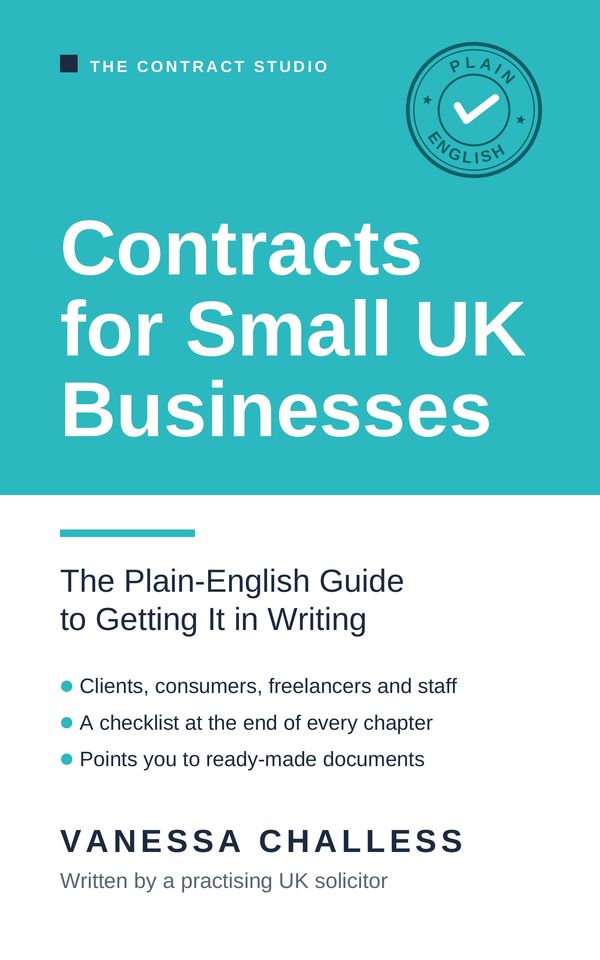
Contracts for Small UK Businesses
The Plain-English Guide to Getting It in Writing
Get it in writing before it matters. A plain-English guide for small UK business owners, freelancers and first-time employers, by a practising UK solicitor.