Every UK limited company has articles of association. Far fewer have a shareholders' agreement, and founders often assume the two are the same thing with different names. They are not. Understanding the shareholders' agreement vs articles of association question matters, because each document binds different people, is changed in a different way and does a different job. Most small founder companies are best served by both, working together.
This post explains what each document is, where they overlap, what happens when they disagree, and where a template stops and a solicitor starts.
What the articles of association are
The articles are the company's rulebook. Every company must have them (Companies Act 2006, section 18). If you formed your company online and never chose your own, you almost certainly have the model articles: when a limited company is formed, the model articles apply so far as the company has not registered its own articles that exclude or change them (section 20).
Which model articles you have depends on when the company was formed. GOV.UK says the current model articles apply by default to companies incorporated on or after 28 April 2013, with an older version for those formed between 1 October 2009 and 27 April 2013. Older companies may still run on a version of Table A.
Three features of the articles matter here:
- They bind everyone automatically. The articles bind the company and its members as if each had signed a contract to observe them (section 33). Someone who buys shares next year is bound without signing anything.
- They are public. Articles are registered at Companies House, and any change must be filed there within 15 days (sections 18 and 26).
- They change by special resolution. That means 75% of the votes (sections 21 and 283).
The model articles are short and generic. They deal with directors' meetings, the chair's casting vote, share certificates, dividends and general meetings. They say almost nothing about the things founders actually fall out over, which is why so much goes wrong without a shareholders' agreement.
What a shareholders' agreement is
A shareholders' agreement is a private contract between the shareholders (and often the company too). It is where founders agree the "what ifs": what happens if one of you leaves, how shares are valued, who can veto big decisions, what happens if you deadlock, and who you can sell your shares to.
If you are still deciding whether you need one at all, start with do I need a shareholders' agreement for my UK limited company.
Because it is a contract, a shareholders' agreement binds only the people who sign it. A new shareholder is not bound until they sign up to it, usually by signing a deed of adherence. It is also private: it is a contract between the signatories rather than part of the articles kept on the public register.
Shareholders' agreement vs articles of association: the key differences
| Articles of association | Shareholders' agreement | |
|---|---|---|
| Who is bound | The company and every member, now and in future | Only the people who sign it |
| Public or private | On the public register | A private contract |
| How it changes | Special resolution (75%) | Usually only with everyone's written agreement |
| Typical content | Board meetings, share certificates, dividends, general meetings | Leavers, valuation, deadlock, reserved matters, transfers |
| If it is broken | The company acts on what the articles say | A claim against the person who broke it |
What happens when they disagree
This is where founders get caught out. Suppose your shareholders' agreement says founders will not use the chair's casting vote, but your model articles give the chair one (model articles, article 13). Or your agreement says shares must be offered to the other founders first, but the model articles simply let the directors decide whether to register a transfer (article 26).
The company follows its articles. Outsiders, such as a bank or a buyer, will look at the articles too. The shareholders' agreement does not change that. What it gives you is a contract claim against a founder who breaks their promise.
The courts have drawn the line clearly. In Russell v Northern Bank Development Corporation Ltd [1992] 1 WLR 588, the House of Lords held that a company cannot contract away its statutory powers, but shareholders can validly agree among themselves how they will vote. That is why well-drafted agreements make the promise one between shareholders, about how they use their votes.
The Founders & Shares agreement works this way. Clause 21.2 says that, between the shareholders, the agreement prevails over the articles, and each shareholder will use their votes, so far as the law allows, to give effect to it. Clause 5.4, on reserved matters, binds the shareholders as shareholders, not the company. The pack's notes are frank that if someone breaks the casting-vote promise, the vote probably still counts and your remedy is a claim against that founder.
Do you need to change your articles?
Not always, but you should check them before you sign anything. The Founders & Shares pack does not amend your articles. It works alongside them and flags where they may need changing. Typical flashpoints are:
- Share transfers. If you want the transfer and leaver rules to bind the company and anyone who later holds shares, not just the signatories, that usually means putting them into the articles.
- The chair's casting vote. It stays in the model articles unless you remove it.
- Directors' conflicts of interest (model articles, article 14).
Amending articles needs a special resolution, a filing at Companies House, and careful drafting so the articles and the agreement say the same thing. That is a job for a solicitor, not a template.
One thing that is not an articles change: switching off the statutory right of first refusal on new shares. A private company with one class of shares can do that by special resolution (section 569). The pack's Signing-Day Pack includes template wording for that resolution and a filing checklist, but you sign and file it yourselves. More on that in our guide to reserved matters and pre-emption rights.
What the Founders & Shares pack covers
The pack is built for a straightforward company: 2 to 4 individual shareholders, one class of ordinary shares, a UK private company limited by shares registered in England and Wales, no outside investors and no live dispute. It includes:
- the Shareholders' Agreement, with leaver rules, deadlock steps, reserved matters, transfer restrictions and an optional drag-along and tag-along;
- a Cross-Option Deed for what happens to a founder's shares if they die (death only);
- a Deed of Adherence for new shareholders, built into the agreement;
- a clause-by-clause guide, a voting worksheet and a Signing-Day Pack.
It does not change your articles, file anything for you or give tax advice. The Read This First guide sets out who the pack suits before you buy.
When you need a solicitor instead
Use a solicitor, not a template, if:
- your articles are not the model articles, or you are not sure what you have;
- you want the leaver and transfer terms written into your articles;
- you have more than one class of shares, more than four shareholders, or a shareholder that is a company or trust;
- you are taking outside investment; or
- you are already in dispute.
For more common questions, see our shareholders' agreement FAQs.
This is general information, not legal advice on your situation.
If your company fits the template, the Founders & Shares shareholders' agreement pack gives you the agreement, the Cross-Option Deed and the signing paperwork in one place.
Sources
- Companies Act 2006, s 18 (articles of association)
- Companies Act 2006, s 20 (default application of model articles)
- Companies Act 2006, s 21 (amendment of articles)
- Companies Act 2006, s 26 (registrar to be sent copy of amended articles)
- Companies Act 2006, s 33 (effect of company's constitution)
- Companies Act 2006, s 283 (special resolutions)
- Companies Act 2006, s 569 (disapplication of pre-emption rights: private company with one class of shares)
- Companies (Model Articles) Regulations 2008, SI 2008/3229, Sch 1, art 13 (casting vote)
- Companies (Model Articles) Regulations 2008, SI 2008/3229, Sch 1, art 14 (conflicts of interest)
- Companies (Model Articles) Regulations 2008, SI 2008/3229, Sch 1, art 26 (share transfers)
- GOV.UK: Model articles of association for limited companies
- Russell v Northern Bank Development Corporation Ltd [1992] 1 WLR 588 (HL)
Related Templates for Founders
Setting up with co-founders? Get our Shareholders' Agreement Pack – the shareholders' agreement, a cross-option deed, a signing-day pack and plain-English guides for UK founder teams. Still deciding? Read the shareholders' agreement FAQ.
Related reading
The Contract Studio Guides
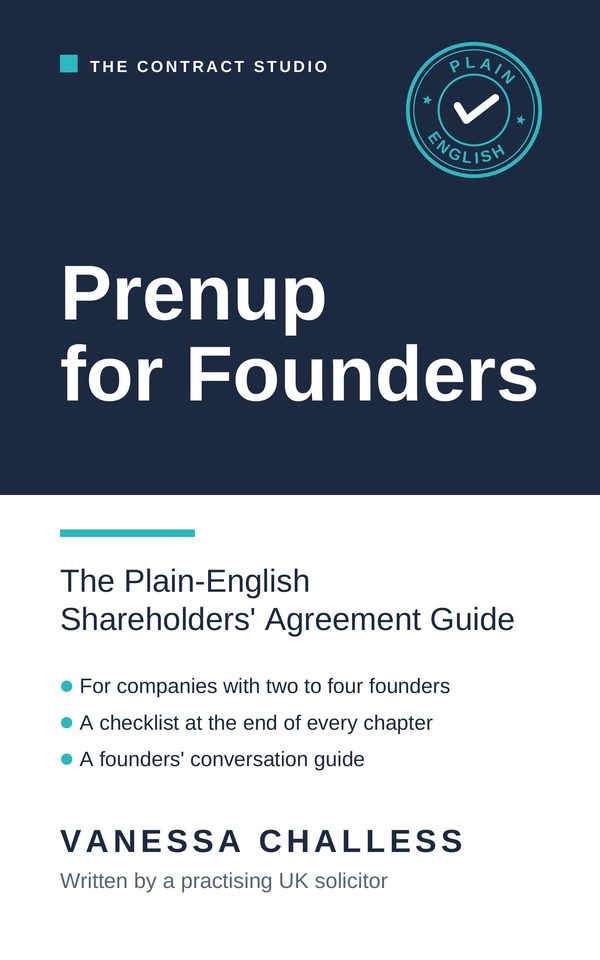
Prenup for Founders
The Plain-English Shareholders' Agreement Guide
The shareholders' agreement every set of co-founders should sign, explained clause by clause in plain English.