Drag along vs tag along is one of those pairs of terms that sound like jargon until the day someone wants to buy your company. Then they matter a great deal. Both deal with the same moment: an outside buyer wants to buy some or all of the shares. One protects the majority who want to sell. The other protects the minority who might otherwise be left behind.
Neither right exists automatically for a small private company. If you want them, you have to write them into your shareholders' agreement or your articles.
Drag-along rights: meaning in plain English
A drag-along clause lets shareholders holding a set majority of the shares require the others to sell their shares to the same buyer, on the same terms.
Why would anyone want that? Because most buyers of a small company want 100% of it. If three founders want to accept a good offer and the fourth refuses, the buyer may walk away. A drag-along stops one holdout blocking a sale that everyone else wants.
The model articles for private companies contain no drag-along. Company law does have a forced buy-out for takeover offers, but it only kicks in once the buyer has made an offer for all the shares on the same terms and has acquired at least 90% of the shares the offer relates to (Companies Act 2006, sections 974 and 979). For a small founder company, a contractual drag-along is the practical tool.
Tag-along rights for minority shareholders
A tag-along works the other way round. If a shareholder sells enough shares to hand control to an outside buyer, the others can insist on selling their shares to that buyer too, at the same price and on the same terms.
Without it, a majority founder could sell to a buyer at a good price and leave a minority founder stuck as a small shareholder in a company now run by a stranger. A tag-along lets the minority leave on the same deal.
Again, company law gives only limited help on its own. A minority shareholder can require a buyer to purchase their shares after a takeover offer, but only once the buyer holds at least 90% of the voting shares and voting rights (section 983). A tag-along clause protects the minority well before that point.
Drag along vs tag along: side by side
| Drag-along | Tag-along | |
|---|---|---|
| Who it protects | The selling majority | The minority |
| What it does | Forces the others to sell | Lets the others join the sale |
| Triggered by | A majority agreeing to sell all their shares | A sale that would give a buyer control |
| Main risk | Minority dragged into a bad deal | Buyer put off by having to buy everyone out |
What to look for in a drag-along clause
A drag-along is a powerful clause, so the detail matters. In the Founders & Shares agreement, the drag-along is in clause 17. It is optional: the drafting note tells you to delete it if you do not want it. If you keep it, this is what it says.
- The threshold. Shareholders holding at least 75% of the shares (a bracketed figure you can change) can trigger it. The threshold counts all the shares.
- A genuine buyer. The sale must be to a genuine third-party buyer at arm's length. A founder cannot use it to force the others to sell to a friend or to themselves.
- Same terms, same price. The dragged founders sell on the same terms, at a price per share at least equal to what the sellers are getting.
- Notice. The Drag Notice must name the buyer and state the price, the other material terms and the completion date, which must be at least 20 business days away (bracketed). It lapses if the sale has not completed within 60 business days (bracketed).
- Limits on what a dragged founder must sign up to. Clause 17.3 says a dragged founder only promises that they own their shares and can sell them. They do not have to give promises about the business, indemnities or restrictive covenants unless they separately agree. Their liability is their own, not shared, and capped at what they receive. Any deferred or held-back part of the price applies to them on the same basis as to the sellers.
- Enforcement. If a dragged founder will not sign the transfer, the power of attorney in clause 15.4 lets the company or the other founders sign it for them. That power is the main reason the agreement is signed as a deed, because a power of attorney must be executed as a deed (Powers of Attorney Act 1971, section 1).
Those limits are what make a drag-along fair to a minority founder. A clause without them can leave someone forced into a sale and then personally on the hook for warranties about a business they did not run.
What to look for in a tag-along clause
The Founders & Shares tag-along is clause 17.6, in square brackets because it is optional too. It applies where a founder's sale to an outside buyer would give that buyer (together with anyone connected with it) more than 50% of the shares (bracketed). The founder cannot complete that sale unless:
- the buyer has first offered in writing to buy everyone else's shares at the same price per share and on the same terms;
- that offer has stayed open for at least 20 business days (bracketed); and
- every accepted sale completes at the same time as the founder's own sale.
That last point matters. A tag-along that only promises an offer, with no tie to completion, can leave the minority waiting while the control sale goes through without them. The clause 17.3 limits on liability apply to tagging founders as well.
How drag and tag fit with the rest of the agreement
Both clauses sit alongside the agreement's right of first refusal on transfers. A sale under the drag-along or tag-along does not go through the usual offer-to-the-others process in clause 12 (clause 17.4). A buyer under an ordinary transfer must also sign a deed of adherence before they become a shareholder.
They also interact with the leaver rules. If a founder has left and their shares are in the compulsory sale process, see our guide to good leaver and bad leaver clauses. And if you are a 50/50 company, a 75% drag-along threshold means neither of you can drag the other: read 50/50 shareholder deadlock before you settle the figure.
Remember too that a drag-along in a shareholders' agreement binds only the people who signed it. If you want it to bind every future shareholder automatically, it needs to be in your articles, and the Founders & Shares pack does not amend articles. Our post on shareholders' agreement vs articles of association explains the difference.
Tax
Selling shares, including under a drag or tag, can have tax consequences for each founder. Take advice from an accountant before you agree a sale.
When a template is not enough
The pack's drag-along and tag-along are deliberately simple. Take advice from a solicitor if:
- you have, or are about to take, outside investors, who will usually want their own drag and tag terms;
- you have more than one class of shares;
- a sale is already on the table and the founders disagree about it; or
- you want anything more elaborate, such as different thresholds for different buyers.
Our shareholders' agreement FAQs cover more of the common questions founders ask.
This is general information, not legal advice on your situation.
The Founders & Shares shareholders' agreement pack includes an optional drag-along and tag-along with the protections above, plus a clause-by-clause guide to help you decide whether to keep them.
Sources
- Companies Act 2006, s 974 (meaning of "takeover offer")
- Companies Act 2006, s 979 (right of offeror to buy out minority shareholder)
- Companies Act 2006, s 983 (right of minority shareholder to be bought out by offeror)
- Companies (Model Articles) Regulations 2008, SI 2008/3229, Sch 1 (model articles for private companies limited by shares)
- Powers of Attorney Act 1971, s 1 (execution of powers of attorney)
Related Templates for Founders
Setting up with co-founders? Get our Shareholders' Agreement Pack – the shareholders' agreement, a cross-option deed, a signing-day pack and plain-English guides for UK founder teams. Still deciding? Read the shareholders' agreement FAQ.
Related reading
The Contract Studio Guides
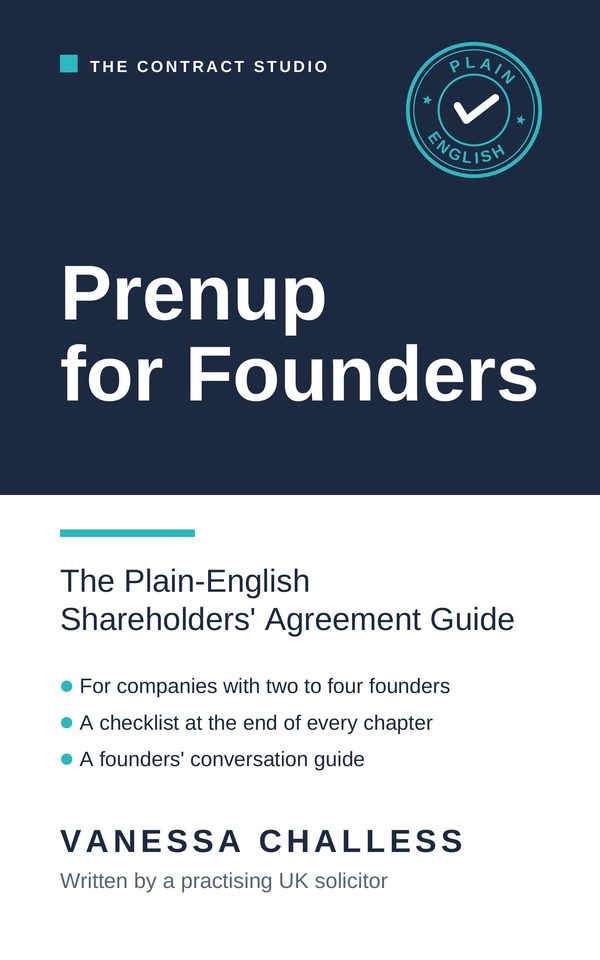
Prenup for Founders
The Plain-English Shareholders' Agreement Guide
The shareholders' agreement every set of co-founders should sign, explained clause by clause in plain English.